
Property-wide deployment thinking
Plan operational visibility around real hotel zones instead of isolated screens.

Support monitored video distribution and controlled operational display workflows in hospitality environments where engineering teams need clearer signal management, approved viewing points and migration flexibility.

Plan operational visibility around real hotel zones instead of isolated screens.

Align engineering decisions, monitoring access and operational workflows across departments.
This brief treats the solution as a controlled internal distribution and viewing project, where signal governance, authorization boundaries and mixed-infrastructure transport are the real design priorities.
Gather internal video sources, service feeds and approved operational signals into one controlled entry layer.
Normalize formats to match the required distribution path and endpoint conditions.
Deliver monitoring or service channels across RF, digital or IPTV environments according to site constraints.
Plan operational visibility around real hotel zones instead of isolated screens.
Align engineering decisions, monitoring access and operational workflows across departments.
These capability blocks explain what the solution should deliver commercially, operationally and technically when it is deployed as part of a real hospitality project.
Publish approved internal video feeds or service channels to designated operational screens with less point-to-point sprawl.
Support properties that must balance legacy RF layers with newer IP-oriented distribution strategies.
Help structure where monitored content is visible and how internal viewing points are segmented across hotel functions.
Reduce fragmented display management by centralizing signal ingestion and distribution planning.
The strongest review path here is to align security leadership, site engineering and project management on approved use cases and boundary control before any endpoint rollout begins.
Review whether the operational visibility model is controlled, scalable and appropriate for approved internal viewing use cases.
Focus on mixed-environment transport logic, source normalization and how legacy RF and IP pathways will coexist.
Define viewing rights, endpoint zones and maintenance ownership early so internal distribution does not become uncontrolled.
The architecture is arranged around source governance, operational distribution control, transport normalization and authorized viewing points inside the property.
Gather internal video sources, service feeds and approved operational signals into one controlled entry layer.
Normalize formats to match the required distribution path and endpoint conditions.
Deliver monitoring or service channels across RF, digital or IPTV environments according to site constraints.
Assign operational screens by department, access requirement and service purpose.
This stack focuses on feed intake, gateway control, RF and IP coexistence, and the operational rules that keep internal viewing disciplined and supportable.
For hospitality operational video distribution, the first challenge is not the screen itself but how approved video feeds are aggregated from VMS, NVR or other internal signal sources.
Operational video often requires format adaptation before it can move into a centralized display or IPTV-style distribution environment.
Operational visibility should be governed as a controlled distribution model with defined endpoint classes, not as ad hoc monitor extension.
Even where the page is not positioning itself as a pure VMS vendor, the operational architecture still needs logging, change control and maintenance rules.
The engineering layer defines who owns each operational boundary, how feeds are normalized and what must be validated before internal displays are enabled.
The topology summarizes how approved operational sources are ingested, normalized and distributed to restricted viewing locations.
Classify feeds by sensitivity, ownership and destination before any distribution path is enabled.
Select encoder or gateway logic according to latency tolerance, format requirements and endpoint design.
Keep operational transport isolated by department, zone and authorization level.
Assign endpoint rights, support ownership and restricted viewing rules before go-live.
A professional solution document should show what systems are involved, why they are connected, who owns each boundary and what must be validated before delivery.
These bullets define what the solution team should explicitly own in design, implementation and handover, so execution responsibility stays clear from the outset.
Professional delivery depends on measurable acceptance. These checks help turn the page from concept presentation into an implementation-oriented technical proposal.
This composition helps stakeholders judge the solution as a managed operational visibility system instead of a loose collection of display points.
Approved NVR, VMS or internal video source handoff with documented feed ownership.
Gateway or encoder normalization matched to target transport path and latency tolerance.
Controlled operational display network segmented by zone, department and authorization boundary.
These items are common expansion directions that can be added when the project budget, timeline and integration boundary support a broader deployment.
Professional proposal pages should also state what is outside the current boundary, so commercial expectations and engineering responsibility stay clear from the beginning.
These recommendations help position the solution as a realistic project path rather than a generic concept presentation.
This gives commercial and technical stakeholders a clearer view of where the solution is strongest and most deployable.
Strong technical proposals should also state what must be true before delivery can succeed at the expected quality level.
These deliverables reflect the approval records, signal maps and commissioning outputs normally needed for a controlled internal distribution project.
Approved feed list, source ownership, sensitivity classification and authorized destination mapping.
Gateway/encoder allocation, VLAN structure, endpoint zone map and restricted-display boundary notes.
Latency checks, endpoint authorization tests, troubleshooting ownership split and maintenance workflow handover.
These scenarios show where controlled operational visibility is most relevant without blurring the line between internal use and public communication.
Replace isolated endpoint logic with a more organized distribution model.
Keep older infrastructure useful while preparing for a more centralized future architecture.
Support engineering, service and operations teams with better internal signal governance.
The typical sequence starts with source approval and distribution policy, then moves into transport setup, endpoint enablement and rights validation.
Identify which internal sources and monitoring feeds should enter the managed distribution layer.
Segment operational endpoints by viewing rights, zone type and technical constraints.
Choose encoding, gateway and headend devices according to source mix and delivery method.
Launch with clear internal governance for feed ownership, access scope and maintenance.
Current catalog products most relevant to this page focus on encoding, modulation, gateway conversion and centralized video delivery foundations.
Centralized service layers used to structure signal governance, feed organization and controlled internal distribution logic.
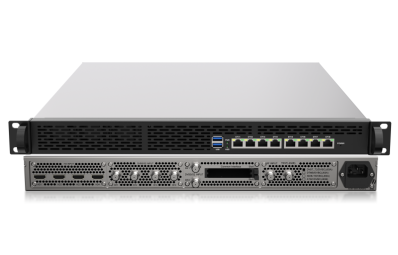
SKD7200N All-in-One Hotel IPTV Server and Streaming Gateway Device is a hotel IPTV streaming server. It is built for hospitality IPTV deployments that need sign...
View ProductInfrastructure components used to normalize source formats and move approved operational signals across mixed hotel environments.
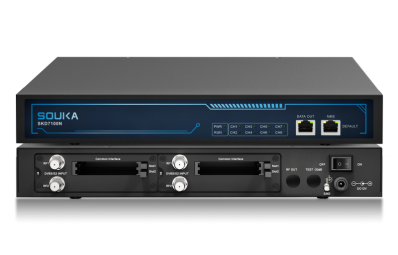
SKD7150P 4 DVB-S/S2 to IPTV Gateway with 4 CAM Cards is a broadcast-to-IP gateway. It is built for hospitality IPTV deployments that need signal acquisition, st...
View Product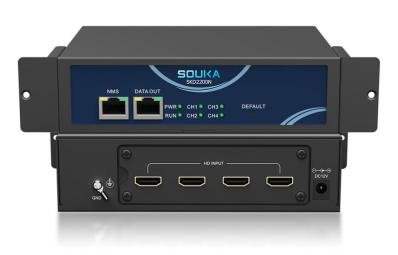
SKD2210 4 Channel HD Encoder for IPTV System is a multi-channel encoder platform. It is built for hospitality IPTV deployments that need signal acquisition, str...
View Product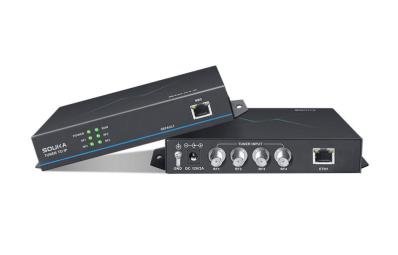
SKD2150 IP Modulator Tuner to IP Headend Systems for IPTV is a digital RF modulation platform. It is built for hospitality IPTV deployments that need signal acq...
View ProductShare your source environment, approved viewing zones, transport constraints and maintenance model. We can then outline the right distribution control, gateway scope and endpoint policy for the project.


By clicking the button, you are agreeing with our Term & Conditions
